
Image: © Kunsthalle Hamburg
Conference:
29–30 May 2025 in Rome
Empty Boxes?
Modeling the Lost and Ephemeral in Premodern Sacred Spaces
International and Interdisciplinary Conference
Rome, 29.–30. May 2025
Bibliotheca Hertziana – Max Planck Institute for Art History
Concept:
Chiara Capulli, Vera Grund, Klaus Pietschmann, Kris Racaniello,
Elisabetta Scirocco, Tobias C. Weißmann
Promoting Institutions:
Bibliotheca Hertziana – Max Planck Institute for Art History
German Historical Institute in Rome
Research Project CANTORIA – Music and Sacred Architecture
Johannes Gutenberg University Mainz
University of Zurich
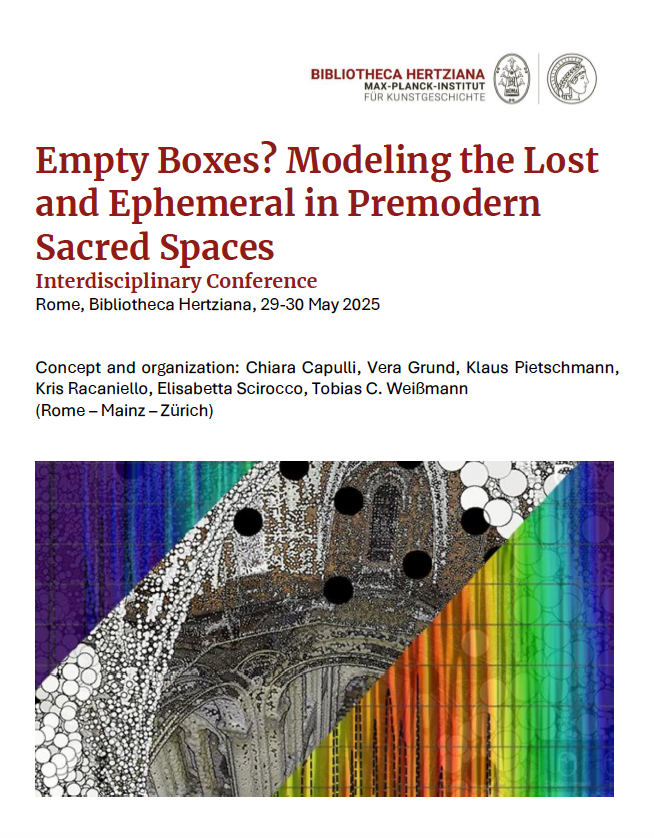
Premodern sacred space was never in stasis. It was moving, active, and filled with materials, objects, sounds, and people that combined to create an atmosphere of the sacred and, sometimes, the miraculous. As space in flux by definition, the sedimented temporality of devotion – ie. the fundamental composition of the space over time – poses many difficulties for historical modeling, conservation, and restoration practices, against the backdrop of the dramatic changes that spaces, installations, and practices have undergone over the centuries.
More durable evidence has won out in the history and historiography of spatial reconstruction. But what of perishable materials, objects, and architectural installations, as well as musical and sonic manifestations? How do we responsibly approach recreating such ephemeral features that once graced these interiors, enlivening the volumes of often-vacant digital models?
Models constitute a frozen image, necessarily in conflict with such activated sacred space. Despite this seemingly contradictory polarization, modeling “snapshots” of activated spaces enriches our understanding and documentation of the past and advances previously stagnant historiographic queries. In particular, immaterial elements such as sound and movement can be made communicable through digital reconstructions. The combination of 3D reconstructions, virtual acoustics (auralizations) and historical performance practice enables immersive simulations of the multi-sensory experience of premodern sacred spaces.
Responding in part to the sensory turn, this workshop seeks papers that address the lost or ephemeral aspects of premodern sacred spaces in two senses:
– material, installation, or object-oriented holistic approaches to reconstruction,
– innovative approaches to modeling or reconstructing embodied experience, visually and aurally induced imaginaries,and sensorial interactions with sacred space through, for example, agent-based modeling.
The decidedly interdisciplinary workshop addresses art and architecture historians, musicologists and musicians, digital engineers, 3D environmental artists, (archeo)acousticians and sound engineers.
Thursday, 29 May 2025
9:15: Tanja Michalsky (Bibliotheca Hertziana – MPI): Welcome
9:30: Chiara Capulli (Bibliotheca Hertziana – MPI), Vera Grund (Deutsches Historisches Institut in Rom), Klaus Pietschmann (Universität Mainz), Kris Racaniello (Bibliotheca Hertziana – MPI), Tobias C. Weißmann (Universität Mainz/Universität Zürich):
Introduction
Sources
Chair: Elisabetta Scirocco (Bibliotheca Hertziana – MPI)
09:50: Eduardo Carrero Santamaria (Universitat Autònoma de Barcelona):
Liturgical Ordinaries as a Source for Not So Empty Boxes
10:30: Gianluigi Viscione (Alma Mater Studiorum – Università di Bologna), Gaia Ravalli (Università degli Studi di Firenze), Marco Toffanin (Università degli Studi di Padova):
In medio ecclesiae: arte, musica e liturgia intorno al tramezzo. Verso la restituzione digitale di tre basiliche mendicanti
11:10–11:30: Coffee break
Spatial Voids: Modeling the Gray Zones I
Chair: Chiara Capulli (Bibliotheca Hertziana – MPI)
11:30: Meredith Cohen (University of California – Los Angeles), Kristine Tanton (University of Montreal):
The Empty Box as a Workspace: The Case of the Lady Chapel of Saint-Germain-des-Prés
12:10: Donal Cooper (University of Cambridge), Fabrizio Nevola (University of Exeter):
Packing Boxes: Reconfiguring Research for the 3D Modeling of Renaissance Church Interiors
12:50: Michela Young (University of Cambridge), Luca Brunke (University of Exeter):
The Rucellai Chapels in San Pancrazio: Developing the Florence4D Workflow for 3D Reconstruction, Focusing on Collaboration and Data Integration
13:30–14:30: Lunch break
Spatial Voids: Modeling the Gray Zones II
Chair: Kris Racaniello (Bibliotheca Hertziana – MPI)
14:30: Charles van den Heuvel (Huygens Institute – KNAW and University of Amsterdam):
A Saint on the Move: Modeling and Representing the Ephemeral and Uncertainties in the History of the Procession of the Holy Relics of St. Servatius
15:20: Hanna Christine Jacobs (Universität Bonn):
Remodeling the High-Medieval Double Chapel of Bonn-Schwarzrheindorf: Chances and Pitfalls of a VR-Environment in Research and Teaching
16:00–16:20: Coffee break
16:20: Piotr Kuroczyński (Hochschule Mainz), Jakub Franczuk (Warsaw University of Technology), Piotr Greiner (Pictureworks and SolidGames, Warsaw):
Immersive Heritage: Combining Digital Reconstruction and Game Technology for Sacred Spaces
17:00: Johns Jenkins (University of York):
“Is That a Photograph?” Responses to the Modeling of St Thomas Becket’s Shrine at Canterbury Cathedral
Friday, 30 May 2025
9:00: Opening remarks
Digitally Reconstructing the Ephemeral: Music, Sound, and Textile Architectures I
Chair: Vera Grund (Deutsches Historisches Institut in Rom)
9:10: Hasan Baran Fırat (University of Antwerp):
“A Fool’s Errand”? Reconstructing Historical Soundscapes: Challenges, Problems, and Methods
09:50: Francisco Prado-Vilar (Universidade de Santiago de Compostela):
Cosmos/Chorus: Ekphrastic Architecture, Immersive Technologies, and the Emergence of the Polyphony in the Horizon of the Year 1200
10:30: Camilla Cavicchi (CNRS), Philippe Vendrix (CNRS and Centre d’études supérieures de la Renaissance):
MusHerMes – Musical Heritage Messenger. Musical Heritage, Non-Spaces and Sustainable Tourism
11:10–11:40: Coffee break
Simulating Sensoriums: Virtual Experiences and the Problem of Sensory Archiving
Chair: Klaus Pietschmann (Universität Mainz)
11:40: Neta Bodner, Amir Winer (The Open University of Israel):
Simulating Sensory Experiences in the Medieval Jewish Ritual Bath of Cologne: Real and Virtual Immersive Experiences
12:20: Bissera Pentcheva (Stanford University):
Film, Digital Reconstructions, and Chant in Staging the Spiritual Seeing of the Golden Statue of Sainte Foy at Conques
13:00–14:00: Lunch break
Digitally Reconstructing the Ephemeral: Music, Sound, and Textile Architectures II
Chair: Tobias C. Weißmann (Universität Mainz/Universität Zürich)
14:00: Margherita Antolini (Politecnico di Torino):
Staging Quarantore Devotion: A Holistic Approach to Festival Studies Through 3D Modeling
14:40: Janie Cole (University of Connecticut):
Music, Acoustics, and Space in the Christian Kingdom of Ethiopia: Modeling Gorgora Iyäsus Re-Imagined (1626–32)
15:20-15:40: Coffee break
15:40: Stefan Morent (Universität Tübingen), Lukas Aspöck (Universität Aachen):
Sacred Sound/Sacred Space – Virtual Acoustic-Visual Reconstruction of Sacred Spaces of the Middle Ages: Towards Virtual Performance Scenarios
16:20: Augustus Wendell (Duke University):
Tracing Space: Computational Approaches to Studying the Ephemeral with Real Time Game Engines
17:00: Round Table Discussion
Chair: Tanja Michalsky (Bibliotheca Hertziana – MPI)